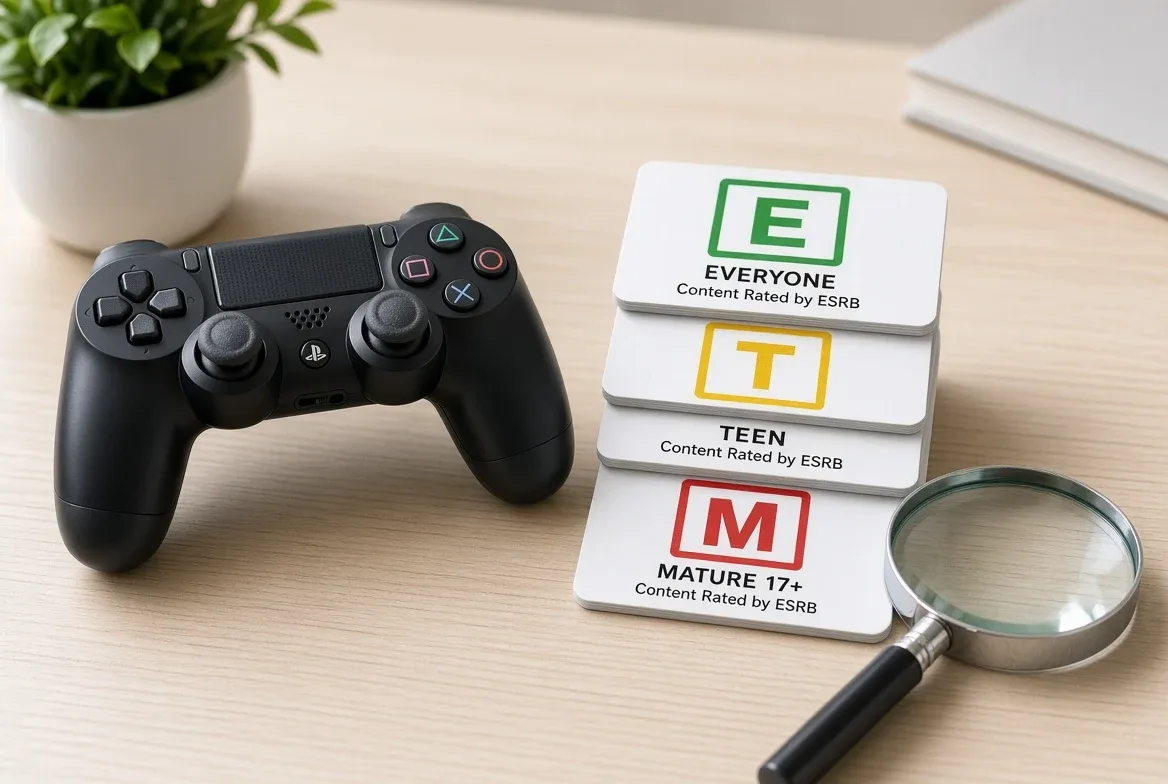
An ESRB rating comes from at least three specially trained, independent raters who review a publisher's own questionnaire and submitted footage of a game's most extreme content, per the Entertainment Software Rating Board's published FAQ. Raters never see who made the game, and their identities stay confidential to keep the process free of industry influence.
Who Actually Assigns the Rating?
The ESRB is the U.S. and Canada's self-regulatory body for console, PC, and mobile game ratings. Publishers do not get to rate their own games. Instead, a publisher fills out a detailed content questionnaire and submits video showing the most intense material in every relevant category — violence, language, sexual content, drug references, and more. A panel of at least three raters, who have no ties to the game industry and whose identities are never disclosed to publishers, reviews that material and independently deliberates on a rating. The ESRB does not require raters to finish a game before rating it; the organization has noted that many modern titles run well past 50 hours, making full playthroughs impractical for pre-release review.
What Do the Six Rating Categories Mean?
ESRB ratings sort games into six bands, each describing an age range, not a difficulty or quality judgment.
| Rating | What It Signals |
|---|---|
| Everyone (E) | Generally suitable for all ages; may include minimal cartoon or fantasy violence, or infrequent mild language. |
| Everyone 10+ (E10+) | Suitable for ages 10 and up; allows more cartoon or fantasy violence and mild language than E. |
| Teen (T) | Generally suitable for ages 13 and up; may include violence, suggestive themes, crude humor, minimal blood, simulated gambling, and infrequent strong language. |
| Mature 17+ (M) | Generally suitable for ages 17 and up; may include intense violence, blood and gore, sexual content, and strong language. |
| Adults Only 18+ (AO) | Restricted to adults; can include prolonged, graphic violence, explicit sexual content, or real-money gambling elements. |
| Rating Pending (RP) | A provisional label used on marketing for a physical game before its final rating is assigned. |
What Are Content Descriptors?
Below each rating, publishers must display content descriptors — short, standardized phrases from a list of more than 30 that name the specific material behind the rating, such as "Blood," "Strong Language," or "Use of Alcohol." Descriptors exist so a parent or player does not have to guess why a game landed at Teen or Mature; the label states the actual trigger.
What Are Interactive Elements, and Do They Change the Rating?
Since 2013, ESRB labels have also carried Interactive Elements — short tags covering features like shared user-generated content, location sharing, unrestricted internet access, and in-game purchases. A version of this label, "In-Game Purchases," flags that a title sells extra digital content after purchase, which can include loot boxes or other randomized items. The ESRB is explicit that Interactive Elements "highlight interactive or online features that may be of interest or concern but do not influence the rating assignment" — they are disclosure, not a factor the raters weigh when setting E through AO.
What Happens If a Rating Turns Out to Be Wrong?
The system relies on publishers disclosing everything relevant up front, so the ESRB backs it with post-release checks. If undisclosed content surfaces after launch, the rating is corrected everywhere it appears — box art, advertising, and digital storefronts — and publishers of physical games, who are contractually bound to ESRB's advertising and packaging guidelines, can face formal sanctions. The ESRB's enforcement system allows for corrective actions and fines reported as high as $1 million for non-compliance. Downloadable content generally keeps the base game's rating; DLC that pushes past that rating's threshold has to be submitted and rated on its own.
Why Ratings Exist for Console Buyers, Not Just Parents
The categories were built primarily to inform purchasing decisions for younger players, but the same descriptors are useful for any adult deciding what a game actually contains before buying it for a console library — since a rating and its descriptors are the one standardized, sourced summary of a title's content that exists before release.
Frequently Asked Questions
Does a higher ESRB rating mean a better or more advanced game?
No. The rating measures age-appropriateness of content like violence or language, not quality, difficulty, or production value. An E-rated game and an M-rated game are simply aimed at different content thresholds, per ESRB's published ratings guide.
Can a game's ESRB rating change after it's released?
Yes. If a publisher failed to disclose relevant content, ESRB corrects the rating everywhere it's displayed after release and can apply formal sanctions to the publisher, per the organization's FAQ on post-release enforcement.
Does the "In-Game Purchases" label mean a game contains gambling?
Not necessarily. It's an Interactive Elements disclosure that a title sells additional digital content, which can include randomized loot boxes; ESRB states this label does not affect or reflect the age rating itself.
For a related gaming news perspective, read How RNG Certification Actually Works for Online Casino Games.