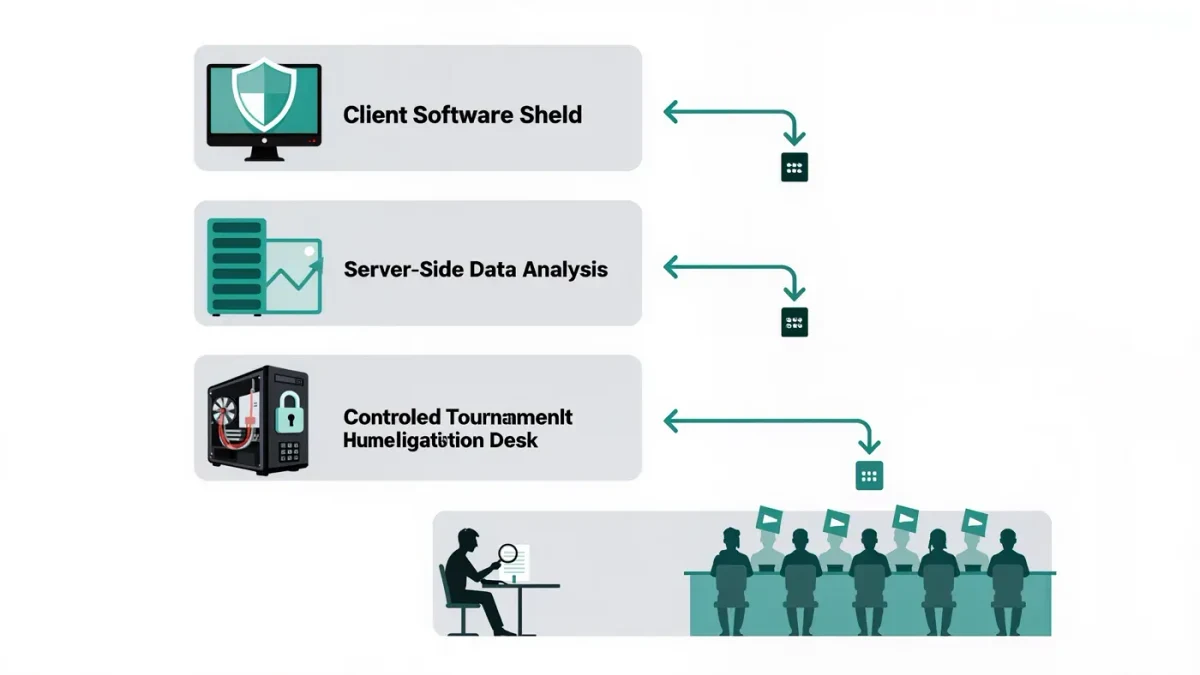
Competitive games defend against cheating with four stacked layers: anticheat software running on the player's PC, server-side detection that flags statistically impossible behavior, tournament rules that control the hardware and environment, and human administrators who investigate and rule on flagged cases. No layer is sufficient alone — client software can be evaded, statistics produce false positives, and humans can be fooled — so top circuits use all four at once. That stack is why professional players accept kernel-level anticheat and why LAN events confiscate phones: each rule exists because someone, at some point, exploited its absence.
What does client-side anticheat actually do?
It runs alongside the game and watches the machine. Modern anticheat systems — Valve Anti-Cheat (VAC), BattlEye, Easy Anti-Cheat, and Riot's Vanguard — scan memory for known cheat signatures, detect the hooks and injections cheats use to read or alter game data, and verify that the game files have not been modified. The most contentious tier is kernel-level anticheat, which loads at system startup with deep access to the operating system, because that is where modern cheats hide from ordinary detection. Vanguard, introduced with Valorant, is the best-known kernel implementation and requires the driver to be active from boot. It is invasive by design, and that trade-off — deep system access in exchange for fewer cheaters — is one of competitive gaming's running arguments.
How does server-side detection catch cheats software misses?
By judging outcomes rather than processes. Servers log every input, shot, and movement; detection systems then look for patterns no legitimate play produces: aim that snaps to heads with inhuman consistency, reaction times below human floor, wallhack-like tracking of unseen enemies, or account behavior typical of boosting and smurfing. Statistical detection catches private cheats that have no client signature to match, which is why ban waves often follow weeks of quiet data collection rather than immediate action — catching a cheat method is worth more than catching one user. Valve has used this model for years in CS and Dota, surfacing results through its banning systems rather than explaining exactly what triggered each detection, to keep cheat developers guessing.
What rules apply at professional tournaments?
Environmental control. On LAN, tournament organizers remove the variables that online play cannot: players use identical tournament PCs with fresh system installs, locked-down accounts, and no internet access beyond the match; peripherals are checked and often firmware-inspected; phones are collected during matches; and coaches communicate only during approved pauses. Configurations are standardized, admins sit behind the stage, and match replays plus telemetry are retained for investigation. These rules respond to documented history: professional cheating scandals, including the 2020 coaching bug scandal in Counter-Strike that led to bans across dozens of coaches, proved that even paid professionals at top organizations will exploit an unsupervised advantage. The aftermath of that scandal was covered widely by outlets including BBC News.
Who investigates and decides cheating cases?
Named humans with published authority. Publishers' anticheat teams handle game-wide bans; tournament organizers and their admins handle event rulings; and independent bodies like the Esports Integrity Commission (ESIC) investigate betting-related match fixing and cheating across affiliated tournaments, issuing sanctions that member organizers enforce. Due process varies: publisher bans are often automated with limited appeal, while ESIC proceedings involve investigation periods and published decisions. For a player accused falsely, the practical defense is the evidence trail — clean hardware, consistent telemetry, and tournament-administered matches — which is exactly what the LAN environment is built to create.
Can anticheat ever fully win?
No, and honest people in the industry say so. Cheats are a market: as long as ranked play and betting create money in winning, someone will sell evasion, and kernel-level cheats escalate the arms race into operating-system territory. What the stack achieves is cost control — raising the price and risk of cheating until casual cheating dies and only expensive, rare tools survive, then catching those statistically or on LAN. The professional game is in decent shape precisely because titles are decided on controlled offline hardware; ranked and online qualifiers, where most players actually compete, remain the contested ground.
Why do bans often arrive in waves instead of immediately?
Because detection is treated as an intelligence game. If a system bans each cheater the moment it flags them, cheat developers learn exactly which behavior triggered the ban and adjust their tools. Collecting observations quietly and acting on many accounts at once hides what the detection knows, which makes each wave more expensive for cheat sellers to absorb. The same logic explains why publishers rarely explain the exact cause of a ban: silence about methods is part of the method. The cost is that flagged players stay in matches for a while, which is frustrating but deliberate.
What does this mean for regular competitive players?
Three practical takeaways. Report and block rather than accuse in chat — automated systems aggregate reports into statistical review, and public accusations change nothing. Keep your own environment clean: unauthorized software sharing signatures with cheat tools has caught innocent players, so do not run unknown injectors or macros on a competitive account. And when a match genuinely matters, prefer tournament-administered play, because the same stack that protects pros — fresh hardware, human admins, retained telemetry — is what makes a result trustworthy.