A middle school in Tampa now has something no other Florida school has: a full esports and broadcasting arena. Sligh Magnet Middle School unveiled the Thaddeus M. Bullard Esports and Broadcast Arena this week, and district leaders describe it as the first facility of its kind in the state, according to Bay News 9.
On paper, the arena has dozens of gaming areas, a 22-foot by 8-foot wall of screens, professional gaming computers and broadcast equipment. But the more interesting number is roughly $3 million — the amount Thaddeus M. Bullard, the local leader and former pro wrestler better known as Titus O'Neil, said will have been invested once the project is finished. There is no official price tag yet, per Bay News 9.
What makes this worth watching is not the hardware. It is the framing. Deputy Superintendent Chris Farkas told the Tampa Bay Times that this is not a playroom but "an opportunity, a career path for students." That is a deliberate shift in how schools present esports — from distraction to instruction — and Sligh is one of the first places in Florida to build an entire room around it.
What is actually inside the arena?
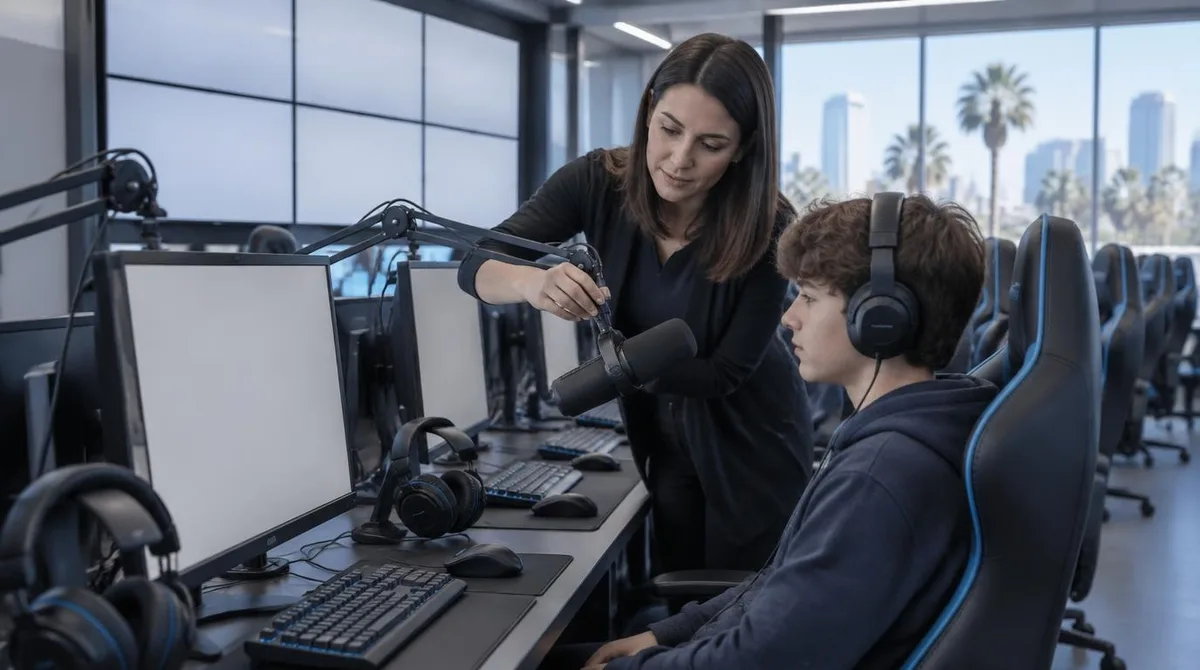
The facility pairs playable space with production space. Students sit in ergonomic furniture at professional gaming computers, and a broadcast booth with production hardware lets them run the show from the other side of the camera, per the Tampa Bay Times.
The first public demonstration showed both halves working at once. Thirteen-year-old JP Guerrero sat behind a neon-lit desk calling a Rocket League match between blue and orange teams in sportscaster fashion, while 10 classmates played in front of him. It was his first try at casting, and the setup is designed so that kind of tryout is routine rather than special.
That dual design matters. A gaming lab teaches students to play. A broadcast arena teaches them to play, produce, commentate and run events — the full pipeline a real esports broadcast needs. Students will learn the technical side of broadcasting along with esports and media production, according to Bay News 9. For a sense of how those on-camera jobs actually work at the professional level, our guide on how to become an esports caster walks the same path these students are starting early. We covered a connected angle in How to Become an Esports Caster: The Real Path From Bedroom Streams to Broadcast Desks.
Why did a former wrestler fund a middle school esports arena?
Bullard, whose foundation already runs the Thaddeus Bullard Academy at Sligh, said his goal has been simple: make students want to be at school. "That's the goal that I've had since I've come to this school and come to this campus," he said, per Bay News 9 — to hear a student say, "You know, I love being at school."
The stakes at Sligh are real. Principal Angela Brown said the school sits in the ZIP codes with the highest levels of poverty, and Bullard noted the school has moved from an F-graded school to a B-graded school, according to the Tampa Bay Times. The arena was built with help from the Bullard Family Foundation, CDW-G — a technology company that works with school districts — and Hillsborough County Public Schools, and it is sponsored by many of the foundation's corporate and community partners.
Guerrero put the recruitment argument better than any administrator could. "There might be a quiet kid sitting in the corner who will be able to take a leadership role here," he told the Tampa Bay Times. That is the engagement case for school esports in one sentence.
What does this mean for esports as a school subject?
Sligh already offers courses in game design and simulation, and Principal Brown said the curriculum will expand. She admitted she was not initially aware of how many careers the esports industry touches, from broadcasting to hospitality, per the Tampa Bay Times. That gap — between what people think esports jobs are and what they actually are — is exactly what a facility like this closes. Our breakdown of esports careers beyond going pro covers the same range of roles. Readers following this should also see Esports Jobs Explained: Careers Beyond Going Pro.
There is also a structural detail that got buried in the announcement: Hillsborough County already has an esports arena at Aquilla Morgan High School in Wimauma, but on a smaller scale, according to the Tampa Bay Times. So this is not a one-off experiment. It is the district scaling a program it has already tested, and choosing a middle school — not a high school — for the flagship version. Students who start casting and producing at 12 or 13 will have years of practice before college recruiting or entry-level jobs come into view.
Could the arena really host state tournaments?
For now, the arena will host classes, clubs and Saturday events for students, per Bay News 9. Bullard said the goal is to eventually host state and national esports tournaments there.
That is the part other districts should watch. A school arena built to competition standard changes what a state esports calendar can look like, because venue cost is one of the practical barriers to school-level tournaments. If Sligh starts hosting them, the facility stops being a classroom asset and becomes regional infrastructure. How school and amateur competitions feed into larger events is covered in our explainer on how esports tournaments actually work.
The evidence so far supports this: a first-of-its-kind Florida facility, a district framing it as career instruction, and a funder measuring success in attendance rather than match wins. What remains unknown is the official cost, the expanded curriculum's shape, and whether the tournament plan materializes. Those are the three things to check when the story updates.