Craps for beginners comes down to three bets: the pass line, the odds bet behind it, and the come bet. That is the whole starter kit. Per Crapsee, the pass line carries a 1.41% house edge, and the odds bet behind it carries none at all. Everything else on the felt costs you more.
The table looks loud because the layout is crowded, not because the game is complicated. A pair of dice decides everything. You bet on what the numbers will do before a seven shows up. Learn the three bets below and you can sit down at any table, online or live, and play correctly.
This guide walks through how a round works, what each of the three bets does, and which parts of the layout to skip. If you want the wider picture of how the house takes its cut, our guides hub collects the odds explainers in one place.
How does a round of craps actually work?
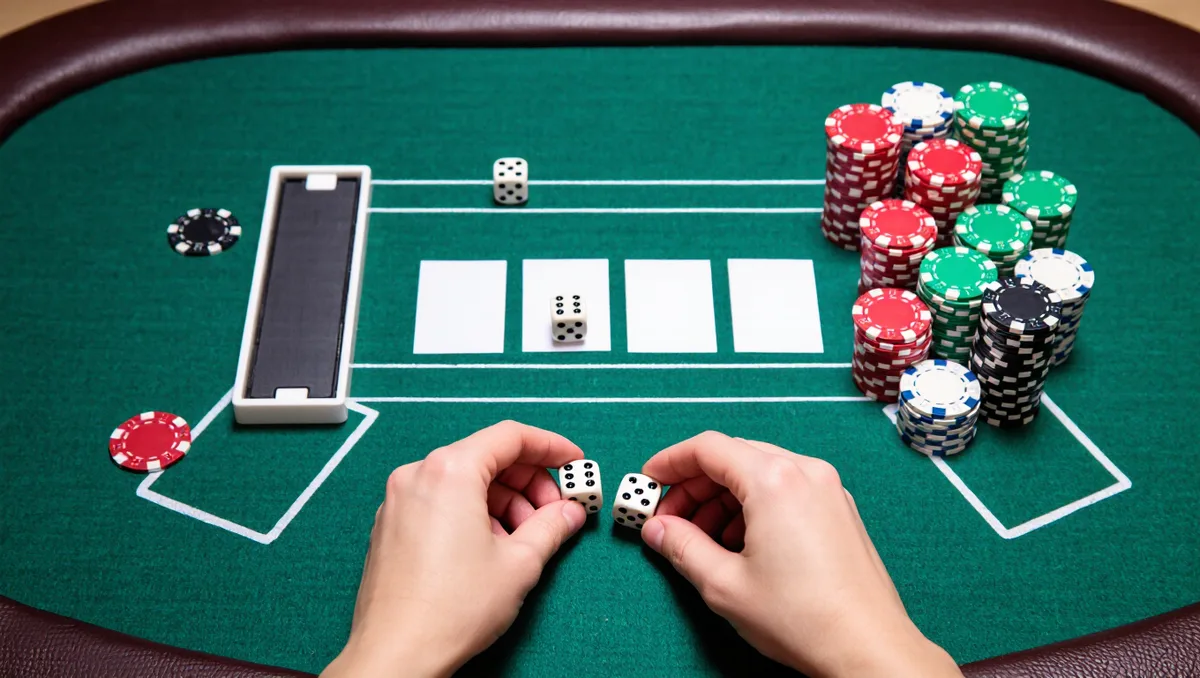
One player, the shooter, rolls two dice. The first roll of a round is the come-out roll. Per the game's published rules, a 7 or 11 on the come-out wins for pass line bets right away. A 2, 3, or 12 loses. Anything else — 4, 5, 6, 8, 9, or 10 — becomes the point, and the round continues.
Once a point is set, the shooter keeps rolling. If the point number rolls again before a 7, pass line bets win. If a 7 comes first, pass line bets lose and the round ends. That is the entire engine of the game. Every other bet on the table is a side wager on the same dice.
As Wikipedia's craps entry explains, the game grew out of the older European game of Hazard and was simplified in the United States in the 19th century, with the pass line as the central wager. The crowds and the chanting are decoration. Underneath, it is a simple question: will the point repeat before a seven?
Why is the pass line the anchor bet?
The pass line is the bet every beginner should make first. You put chips on the pass line before the come-out roll. It wins even money on 7 or 11, loses on 2, 3, or 12, and rides on the point numbers. The 1.41% house edge, per Crapsee's published figures, is among the lowest you will find on any casino floor.
For comparison, the edge on European roulette's single-zero wheel is 2.7%, which we break down in European vs. American Roulette: Where the Odds Differ. The pass line beats that. It does not beat the house — nothing does, over time — but it takes the smallest toll the game offers on a line bet.
What makes the odds bet different from everything else?
After a point is set, you can put extra chips directly behind your pass line bet. This is the odds bet, and it is the one genuinely fair wager in the casino. Per Playpager's craps rules and payouts table, odds bets pay true odds: 2:1 on points of 4 or 10, 3:2 on 5 or 9, and 6:5 on 6 or 8. Because the payout matches the true probability, the house edge on the odds bet is zero.
What this means in practice: the odds bet does not erase the edge on your original pass line bet, but it dilutes it. The more of your total wager that sits in odds, the closer your overall action gets to break-even math. Casinos cap how much odds you can take. The Wizard of Odds practice game uses the common 3-4-5x structure, meaning you can back a point with up to three times your pass bet on 4 and 10, four times on 5 and 9, and five times on 6 and 8. Limits vary by casino, so check the placard on the table.
One caution, stated plainly: no combination of bets removes the house edge over time. Any single session can win or lose. The odds bet simply makes the cheapest game in the building slightly cheaper per dollar wagered.
When should you use a come bet?
A come bet works exactly like a pass line bet, but you place it after the come-out roll, while a point is already working. Per Playpager's payout table, it pays 1:1 on the same rules — 7 or 11 wins, 2, 3, or 12 loses, and the next number the shooter rolls becomes that come bet's own point.
Beginners can skip the come bet entirely and lose nothing. Its value is pace and coverage: if you want more numbers working at once without raising the stakes per bet, come bets let you do it at the same low edge as the pass line. If you would rather watch one number at a time, one pass bet with odds behind it is a complete, correct way to play.
Which bets should beginners skip?
The center of the table is where the house edge lives. Playpager's strategy notes are direct about this: start with pass line and come bets, which carry low edges, and avoid the proposition bets in the middle of the layout, because the odds there run heavily against you. Any 7, hardways, horn bets, and the field are all priced worse than the line bets — some of them by a wide margin.
The same principle shows up in other games where the paytable decides the cost. Our Video Poker Pay Tables piece makes the same point from a different game: the printed payouts are the whole story, and the worst-printed bets are the most expensive ones. We covered a connected angle in Video Poker Pay Tables: What Full Pay Really Means.
Skip the center. It is designed to catch the eye, and it does, but the math never favors it.
Practical steps before you sit down
Free practice tables make the learning cheap. Crapsee's free game runs real craps rules and payouts in a browser with no signup and no real money, and Playpager offers a similar free simulator with an automated dealer. Both are useful for the same reason: the math behaves the way the published figures say it will, so what you learn transfers.
- Watch a few rounds before betting, so the rhythm of come-out and point rolls is familiar.
- Place one pass line bet. Leave it alone until the round resolves.
- Once a point is set, add odds behind it — the amount is your call, within the table's limit.
- Add a come bet only when you want a second number working.
- Set a loss limit before you play and stop when you reach it.
Real-money craps is for adults only, and rules and availability vary by jurisdiction, so check the law where you live. Never bet more than you can afford to lose, and treat the table as paid entertainment with a built-in cost — because that is what it is.
What the evidence establishes — and what it doesn't
The sourced figures are solid: a 1.41% edge on the pass line, true-odds payouts on the odds bet, and clearly worse pricing on the proposition bets. What the math cannot promise is a winning session. Craps is a negative-expectation game no matter how you slice the layout, and variance will hand you both hot rounds and cold ones.
The trade-off a beginner actually faces is this: the three-bet approach is boring and correct, while the flashy center bets are exciting and expensive. Choose boring first. The excitement will still be there on the pass line, and it will cost you less.