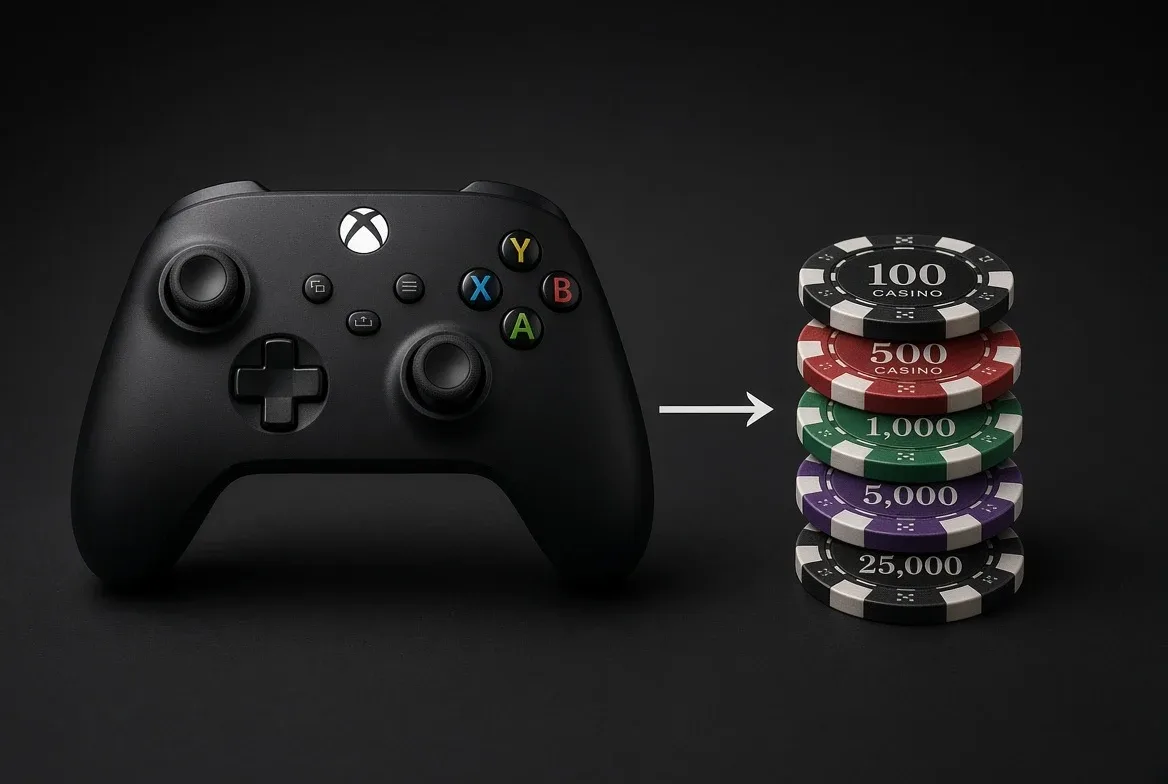
Xbox games can look exactly like a casino floor — spinning reels, stacked chips, a felt table — but they do not pay out real money. Microsoft's published Store Policies bar real-world gambling transactions in the United States outright, and digital goods bought inside a product "cannot be converted to, or exchangeable for, any legally valid currency."
That is the whole story of casino content on Xbox. The games exist, and plenty of them are sold as entertainment with an in-app purchase model. What they do not do is take a wager and hand money back.
What does Microsoft's policy actually say about gambling apps?
Real-money gambling sits in section 11.14 of the Microsoft Store Policies. Apps that "process real-world gambling transactions" must carry an 18+ age rating and use a secure third-party payment API. The same section states that real-world gambling "is not permitted" in a list of markets that includes the United States, Brazil, Chile, China, Russia, Singapore, Taiwan, the Republic of Korea and India.
The definition is deliberately wide: "Real-world gambling includes any payout of winnings which can be converted into items of real-world value," per the policy. A second clause closes the other door. Under 10.8.1, digital goods sold through Microsoft's in-product purchase API cannot be converted into legally valid currency, physical goods or services, and cannot be traded or exchanged on outside marketplaces.
Read the two together and the mechanism is clear. Chips bought in an Xbox casino game are a consumable. Money moves one way.
So what are those Xbox slots and poker titles?
They are social casino games: casino mechanics with no cash payout. You buy chips, you spin or you deal, and the chips have no exit value. Because nothing pays out, the usual measuring sticks of casino math — house edge, RTP, a paytable's long-run return — do not describe your financial outcome. What you paid is your outcome.
That distinction is worth holding onto, because these games borrow the vocabulary of real casino math. On a real-money slot, a return-to-player figure is the provider's stated share of wagered money returned across a very long run, and it never promises anything about one session. In a game with no cash-out, an on-screen return percentage moves virtual chips and nothing else.
How do the ratings tell you which kind of game you are buying?
The ESRB ratings guide separates three gambling descriptors, and the wording carries the difference. "Gambling Themes" covers "prominently featured images or activities that are typically associated with real-world gambling even if they are not directly simulating a gambling experience." "Simulated Gambling" means the "player can gamble without betting or wagering real cash or currency," and is "typically assigned to simulations of casino-based gambling." "Real Gambling" means the "player can gamble, including betting or wagering real cash or currency."
The guide also ties that content to rating tiers. It describes Teen material as including "minimal simulated gambling," while "gambling with real currency" appears in its description of the Adults Only 18+ category.
| ESRB descriptor | What the guide says it means | Real cash involved? |
|---|---|---|
| Gambling Themes | Imagery or activities associated with real-world gambling, "even if they are not directly simulating a gambling experience" | No |
| Simulated Gambling | Player "can gamble without betting or wagering real cash or currency" | No |
| Real Gambling | Player "can gamble, including betting or wagering real cash or currency" | Yes |
Descriptor wording as published in the ESRB ratings guide, checked 20 August 2026.
Who assigns an Xbox game's rating?
For digital submissions, Microsoft's policy requires the developer to complete the International Age Rating Coalition questionnaire in Partner Center, and makes the developer "responsible for accurately completing" it. IARC describes itself as "a streamlined global age rating system for digitally delivered games and apps," and lists Microsoft among the participating storefronts alongside Google Play, Nintendo, Sony PlayStation and Epic Games.
One consequence is structural. The rating is generated from a developer's own answers at submission, not assigned after an outside tester plays the finished game. Microsoft's policy 11.11.3 adds a backstop: a product serving content that might warrant a higher age rating than the one it carries must let users opt in through a content filter or a pre-existing account sign-in.
Do loot boxes count as gambling on Xbox?
Whether a randomized in-game purchase is legally gambling is a question answered differently in different jurisdictions, and this article does not resolve it. What Microsoft requires is disclosure. Policy 10.8.4 states that if a game offers "loot boxes" or other mechanisms that provide randomized virtual items, the publisher "must disclose the odds of receiving each item to customers prior to purchase."
Those odds may be published in-product, on the Store product description page, or on a developer or publisher website linked from the store page. The practical point for a player is simple: the numbers are supposed to be written down before you spend. Read them.
How do you block casino-style content on a console?
The ESRB's parental-controls guidance for Xbox consoles lists four levers: block by age rating, control spending, limit time spent, and restrict communication. Blocking by age rating is the one that catches gambling content, because material involving real-currency gambling falls into the adults-only tier, and simulated gambling pushes a title up the scale as well.
Spending controls are the second lever, and on a platform where casino-style games make their money from chip purchases, they are the one that bites. The ESRB notes that devices have settings to limit or block spending on in-game purchases, and that some can be set to give a child a fixed allowance instead.
What if you are looking for real-money casino play?
Real-money gambling is for adults only — 18+ or 21+ depending on the jurisdiction — and whether it is lawful where you live is a question for local law, which varies and changes. This is information, not legal advice. Xbox is not the venue in any case: Microsoft's own policy excludes real-world gambling transactions from the United States market. And where casino games are played for money, they are paid entertainment with a built-in cost that no strategy or system removes over time; any single session can win or lose.
For a related gaming news perspective, read How RNG Certification Actually Works for Online Casino Games.