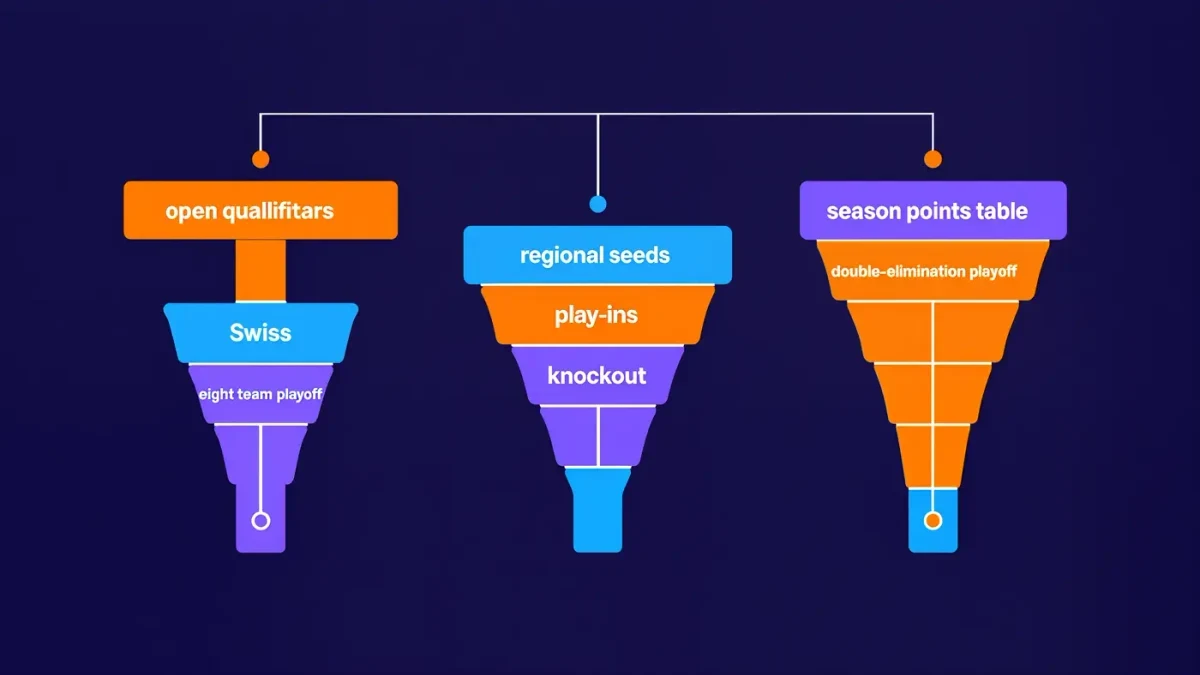
The Valorant Champions Tour (VCT) is Riot Games' global competitive system for Valorant, restructured into its current form for the 2023 season. It works as one yearly pyramid: four regional international leagues feed two international Masters tournaments, and the year ends at Champions, the world championship. Since 2024 the structure has also included a second-tier Challenger ecosystem below the main leagues, giving promoted teams a path upward. A team's VCT year therefore has three kinds of stakes — league standing, Masters performance, and championship points — all of which converge on qualifying for Champions.
What are the four international leagues?
The top tier of VCT: the Americas league, the EMEA league, the Pacific league, and the China league, each run by Riot with partner organizations that hold long-term slots. Each league stage runs in person at a regional studio — Los Angeles for Americas, Berlin for EMEA, Seoul for Pacific — while China operates its own competitive structure feeding into the international calendar. League play is split into stages per season, and standings in each stage determine which teams represent the region at the international events. The partner model replaced the 2021-2022 open-circuit design, trading open promotion for financial stability: partner teams receive support and revenue sharing, and there is no relegation within the league year.
What are VCT Masters events?
The two mid-season world tournaments. Each Masters brings the top teams from all four leagues together — typically the top two or three per region depending on the event — to play a seeded double-elimination or modified-group bracket at a live venue. Masters serve double duty: they crown an international champion twice a year, and they award championship points that count toward Champions qualification. Winning a Masters is a genuine title — international, best-of pressure, all four regions present — but it is not the world championship; that distinction belongs to Champions.
What is Champions, and how do teams qualify?
Champions is the VCT world championship, held at the end of each season since 2021. Qualification comes through three channels combined: final league standings across the season's stages, championship points accumulated from Masters and league results, and a last-chance regional qualifier that awards the remaining slots to teams that missed direct qualification. The event itself uses a group stage feeding a double-elimination or playoff bracket that has varied by year, ending in a best-of-five grand final. Because qualification mixes season-long consistency with one last-chance window, a team can reach Champions through either a strong year or a hot qualifier run — but not through reputation.
How do Challenger and Game Changers fit in?
They extend the pyramid in two directions. Challengers is the tier below the international leagues: organized regionally, it crowns teams that earn promotion to the main leagues through Ascension, the end-of-year tournament that has, since 2023, promoted winning organizations into partner-league slots for following seasons — the open door in an otherwise closed system. Game Changers is Riot's competitive program for women and marginalized genders, running its own regional circuit and world championship. Both are VCT-branded, with their own paths and titles rather than being side events.
Why did Riot change the format in 2023?
To fix instability in the original open circuit. From 2021 to 2022, VCT ran as open qualifiers into Masters and Champions events; any team could enter, but organizations had no guaranteed income, rosters churned, and Riot had no year-round product to sell to sponsors and broadcasters. The partnership model — announced in 2022 and launched with the 2023 season — brought in a fixed set of organizations per league with revenue sharing, weekly league play, and stable venues, copying the franchise economics that League of Legends esports had already adopted. The cost was openness, and Riot answered it by adding Ascension promotion from Challengers, keeping a merit path into the top leagues. The structural shift and the economics behind it have been covered by business outlets such as Bloomberg in reporting on Riot Games.
What are championship points, exactly?
The season-long currency of VCT qualification. Points are awarded for results in league play and at Masters, and they accumulate across the whole year rather than resetting when a stage ends. Their purpose is to reward consistency: a team that performs well all season without winning an event can still qualify for Champions on points, even if it stumbles late. The system also explains why an otherwise quiet Masters finish can still matter — a deep run there banks points that keep a team's championship hopes alive deep into the schedule.
What should a new viewer follow first?
Your region's league stage, then both Masters, then Champions. League play runs on a predictable weekly schedule in one time zone, so it is the easiest entry point, and by Champions you already know the storylines: which region dominated Masters, which qualifier team is surging, and which partner organization is fighting to keep its slot relevant. Unlike a one-off cup, VCT rewards following the year — the standings, the points, and the promotion race all carry meaning into the final event.