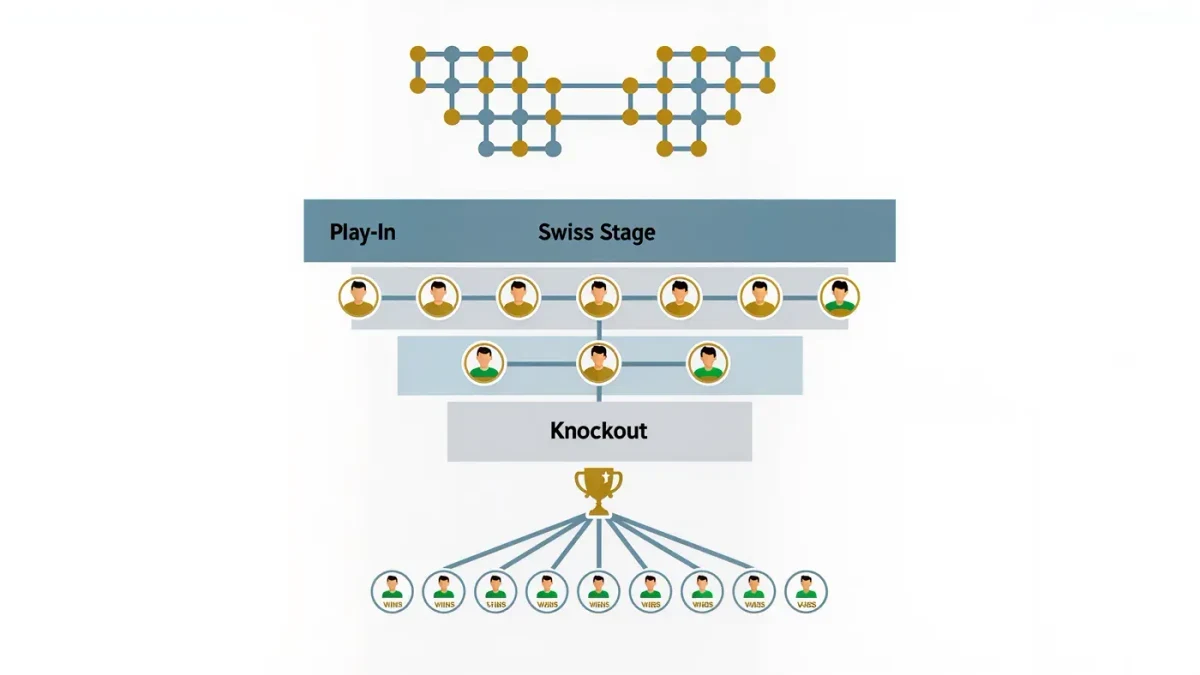
The League of Legends World Championship — Worlds — runs in three stages each autumn. Teams from regional leagues first fight through a play-in round, survivors join the seeded teams in a Swiss stage, and the last eight advance to a single-elimination knockout bracket that ends with the Summoner's Cup final. Since 2023 the event has used this Swiss-plus-knockout structure with around 24 participating teams, replacing the group-stage format used in earlier years. The system rewards consistency across multiple best-of-ones and best-of-threes rather than one lucky run.
How do teams qualify for Worlds?
Through their regional leagues. Riot Games operates regional leagues around the world — the LPL in China, the LCK in Korea, the LEC in Europe, the LCS in North America, and leagues across other regions such as the PCS, VCS, and CBLOL. Each league sends a set number of seeds to Worlds based on historical performance, with the strongest regions earning more. Most seeds go to a league's playoff finalists; the lowest seeds from major regions enter the play-in stage, as do champions from smaller regions. A mid-season tournament, MSI, also affects how many slots a region gets. In short: you qualify by finishing high in your domestic league, and where you finish determines where you enter the Worlds bracket.
What happens in the play-in stage?
The entry layer. Eight teams — typically minor-region champions and the lowest seeds from major regions — are drawn into double-elimination brackets. Teams that lose twice are out of the tournament; those that survive advance to the Swiss stage. The play-in exists to give smaller regions a real path into the main event while keeping the number of Swiss-stage teams manageable. It also produces some of the event's biggest upsets: major-region seeds have been eliminated here before playing a single Swiss match.
How does the Swiss stage work at Worlds?
Since 2023, sixteen teams — the eight Swiss seeds plus eight play-in survivors — enter a Swiss system. Every team plays opponents with the same win-loss record each round. Three wins qualify a team for the knockout stage; three losses eliminate it. The early rounds are best-of-one, which keeps the schedule tight, while elimination and qualification matches are best-of-three, so no team goes home on a single game. The Swiss approach fixed a known flaw of the old four-team groups, where one strong team could miss the knockout round purely because of a single unlucky draw.
What is the knockout stage format?
Eight teams, single elimination, best-of-three series until the final, which is best-of-five. Bracket seeding comes from Swiss-stage records, and teams from the same region can be kept apart in the quarterfinal draw where the rules allow. One lost series ends a run — there is no lower bracket at Worlds, unlike some other circuits. The two teams that navigate the bracket meet in the grand final for the Summoner's Cup, the trophy that has defined the championship since 2011.
Why did Riot change the Worlds format in 2023?
To solve the dead-rubber and draw-luck problems of the old groups. Under the pre-2023 format, four teams played a double round-robin and the top two advanced; fans criticized it because marquee matches between strong teams could mean little, and a bad draw could pair two title contenders in the same group. The Swiss stage guarantees every team plays meaningful matches until it is qualified or eliminated, and the best-of-three qualification and elimination games reduce variance. Riot announced the change ahead of the 2023 event, and it has been retained since.
How long does Worlds run, and where is it held?
Roughly five to six weeks, from late September or early October to a final in November, moving between host cities — recent editions spread play-ins, Swiss, and knockouts across multiple venues, ending in a large-capacity arena final that has filled stadiums from Paris to Seoul to San Francisco. Matches are broadcast in many languages simultaneously, and the musical opening ceremony has become its own tradition. Riot Games, which owns both the game and the event, runs Worlds as the culmination of its yearly competitive calendar, a structure business press such as Bloomberg has covered while tracking Riot's growth under Tencent ownership.
Does seeding carry over between stages?
Yes — performance in one stage shapes where a team enters the next. Play-in survivors join the Swiss stage rather than leading it, and Swiss records decide the knockout bracket's quarterfinal pairings. The effect is that nothing resets along the way: a team that stumbles early faces harder paths later, while a clean run through Swiss earns a more favorable draw in the knockouts. That continuity is a large part of why the format is described as rewarding consistency — the whole tournament works as one connected record rather than three separate events.
What should a new viewer watch first?
The knockout stage. Swiss rounds reward following a favorite team day by day, but the quarterfinals onward are where format tension peaks: best-of-three series, no second chances, and a patch-meta weeks in the making. If you want to understand why a region dominates any given year, watch its seeds' Swiss matches — the level gap between regions shows most clearly there, before the bracket narrows the field to the world's top eight.