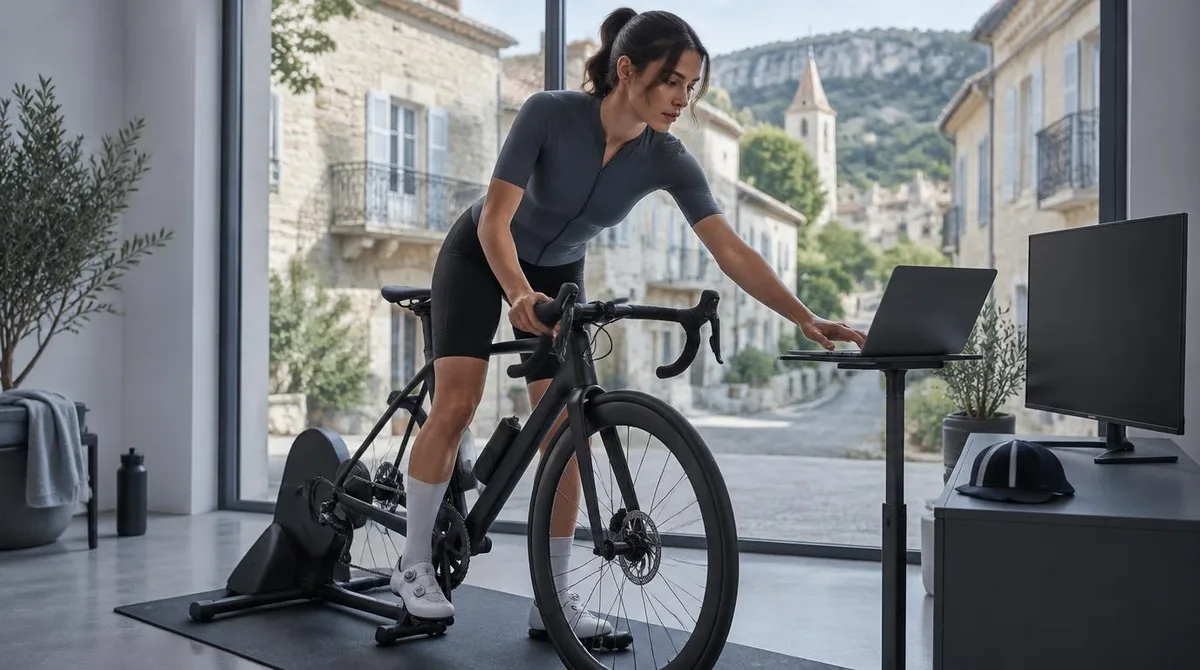
Cofidis have signed Gabriela Guerra, the Brazilian who finished runner-up at the Esports World Championships in both 2024 and 2025, on a two-year professional road contract. The deal is real and earned on the road as well as the trainer: Guerra only took up outdoor racing last September, joined German Continental team Wheel Divas, and won the French 1.2 Mirabelle Classic this season, per Yahoo.
The interesting question is not whether Guerra deserves a chance. She has clearly earned one. The question is what this signing actually proves, and the honest answer is: not much yet. Guerra herself framed it as an experiment. "I want to find out whether I can transfer my strengths from e-cycling to the road," she said, according to Yahoo. That is the right framing, and it cuts against the more excited version of this story doing the rounds. This connects to our earlier piece, How FPS and Refresh Rate Actually Work.
Virtual racing on Zwift and road racing overlap in one obvious place: the engine. A rider who can push big numbers indoors for an hour has the raw aerobic machinery road racing demands. But the overlap ends there. Bike handling in a peloton, cornering at speed, positioning in a bunch of 100 riders, racing in weather, on descents, over cobbles — none of that is tested on a smart trainer. Guerra's own race record reflects the gap. Her road experience amounts to several one-day races this season, including Binche-Chimay-Binche and the Women's GP Stuttgart, alongside that Mirabelle Classic win, per Yahoo. One win in a French 1.2 race is promising. It is not a body of evidence.
What the record actually shows
The esports pedigree is genuine and current. Guerra, 32, took silver at the 2024 and 2025 Esports World Championships, and she has built a public racing career on Zwift, including a YouTube channel charting her progress, per Yahoo. She is one of the world's top virtual racers. That part of the CV survives a second viewing.
The road part is thinner. She moved to cycling from mountain biking — and before that from skateboarding, having moved from Brazil to Germany — and started road racing only last September. Cofidis sport manager Raphael Jeune pointed to "some very promising qualities on the road" and a "real determination to succeed" in her late-season races, per Yahoo. Note what that quote does not say. It does not say she has proven anything at WorldTour level. It says the team is keen to find out. Readers following this should also see Why Xbox Casino Games Never Pay Out Real Money.
That distinction matters, because the headline framing — esports star turns pro — flatters the pipeline more than the results so far justify. Guerra is 32. She is starting a two-year deal with roughly one full season of amateur and Continental racing behind her. The age is not disqualifying, but it compresses the timeline. A 22-year-old with the same record would be a development bet with years to run. Guerra's bet has to pay off quickly.
She is not the first, and the earlier cases cut both ways
Guerra joins a list that includes Jason Osborne, Jay Vine, Ella Harris, Neve Bradbury, Mattia Gaffuri, and recent Zwift Academy winners Emily Dixon and Noah Ramsay, per Yahoo. The existence of that list is often cited as proof the pathway works. It proves something narrower: that teams keep signing from it. Some of those names have gone on to real road success. Others have not, and the list is presented without that sorting. A pipeline is only as good as its conversion rate, and no conversion rate is offered here.
The fair reading sits between the two camps. The Zwift-to-road pathway has produced at least some riders who made it, which means the signing is not a publicity stunt. But the pathway's hit rate is not established by this announcement, and each signing is still an individual bet on an unproven transfer of fitness to road craft.
Why Cofidis's deal structure makes sense
The two-year term is the most sensible detail in the announcement, per Yahoo. It gives Guerra a season to learn the craft without a single-year prove-it knife hanging over her, and it gives the team an exit if the transfer does not take. For a 32-year-old converting from virtual racing, that structure is more honest than a long contract would be. Both sides know what they are testing.
Guerra, for her part, showed no false modesty and no false confidence. She said the late-season races gave her confidence and caught Cofidis's attention, and that she has "no particular apprehensions, just a huge amount of enthusiasm," per Yahoo. Enthusiasm is not a performance metric. But self-selection matters: riders who want the challenge badly tend to do the unglamorous work it requires.
The measured view
So: smart bet or gamble? It is a bet with a defined cost and a plausible upside, which is what most signings are. Guerra has demonstrated world-class fitness in a format that measures it directly, plus a real road win in her first season of racing. What she has not demonstrated is whether that fitness survives contact with professional road racing — the pelotons, the positioning, the tactics, the weather. Cofidis's own language, and Guerra's, both concede that point.
The story worth following is not the signing itself but the second year of the contract. If Guerra is racing regularly and competitive at a higher level by then, the Zwift pathway earns another point in its column. If she is not, this becomes one more data point that raw engine does not equal road racer. Either outcome is useful. Neither is knowable yet, and anyone telling you otherwise is selling a narrative the results do not yet support.